Introduction
You read your notes. You highlight the important parts. You read them again. The material feels familiar, and you feel ready for the exam. Then you sit down to take it, and half of it is gone.
This gap between feeling prepared and actually remembering is one of the most common problems students face. It happens because most standard study habits rely on passive learning — absorbing information without actively retrieving it. Active recall vs passive learning is not just an academic debate; it directly determines how much you retain.
This guide covers what active recall and passive learning are, why the science consistently favors one over the other, and what concrete steps you can take to make your study sessions more effective.
What Is Passive Learning?
Passive learning means receiving information without being required to reproduce it. Re-reading textbook chapters, highlighting notes, watching lecture videos, and copying out definitions all fall into this category.
These methods feel productive because they’re familiar and low-effort. The problem is that familiarity is not the same as memory. When you re-read something, you recognize it — but recognition is a much weaker form of recall than being able to produce the answer from scratch.
Common passive learning habits:
- Re-reading notes or textbooks
- Highlighting or underlining text
- Copying out summaries
- Listening to recorded lectures passively
- Reviewing completed flashcards without self-testing
What Is Active Recall?
Active recall means deliberately retrieving information from memory without looking at the source material. Instead of re-reading an answer, you force yourself to generate it — then check whether you were correct.
The act of retrieval itself strengthens the memory trace. Each time you successfully pull information from long-term memory, that pathway becomes more durable and easier to access later.
Common active recall methods:
- Flashcards (answering before flipping)
- Practice tests and past papers
- The Feynman Technique (explaining a concept in plain language from memory)
- Closing your notes and writing down everything you remember (brain dump)
- Self-quizzing with questions written in the margins of notes
The Science: Why Active Recall Works Better
The advantage of active recall over passive review is well-documented in cognitive science. A landmark study by Roediger and Karpicke (2006) found that students who used retrieval practice recalled significantly more material one week later than students who re-studied the material. The effect held even when the re-study group spent more total time reviewing.
This phenomenon is known as the testing effect — the finding that being tested on material improves retention more than additional exposure to it. The explanation lies in how memory consolidation works: passive review keeps information in working memory temporarily, while retrieval practice forces the brain to reconstruct the memory, reinforcing it in long-term storage.
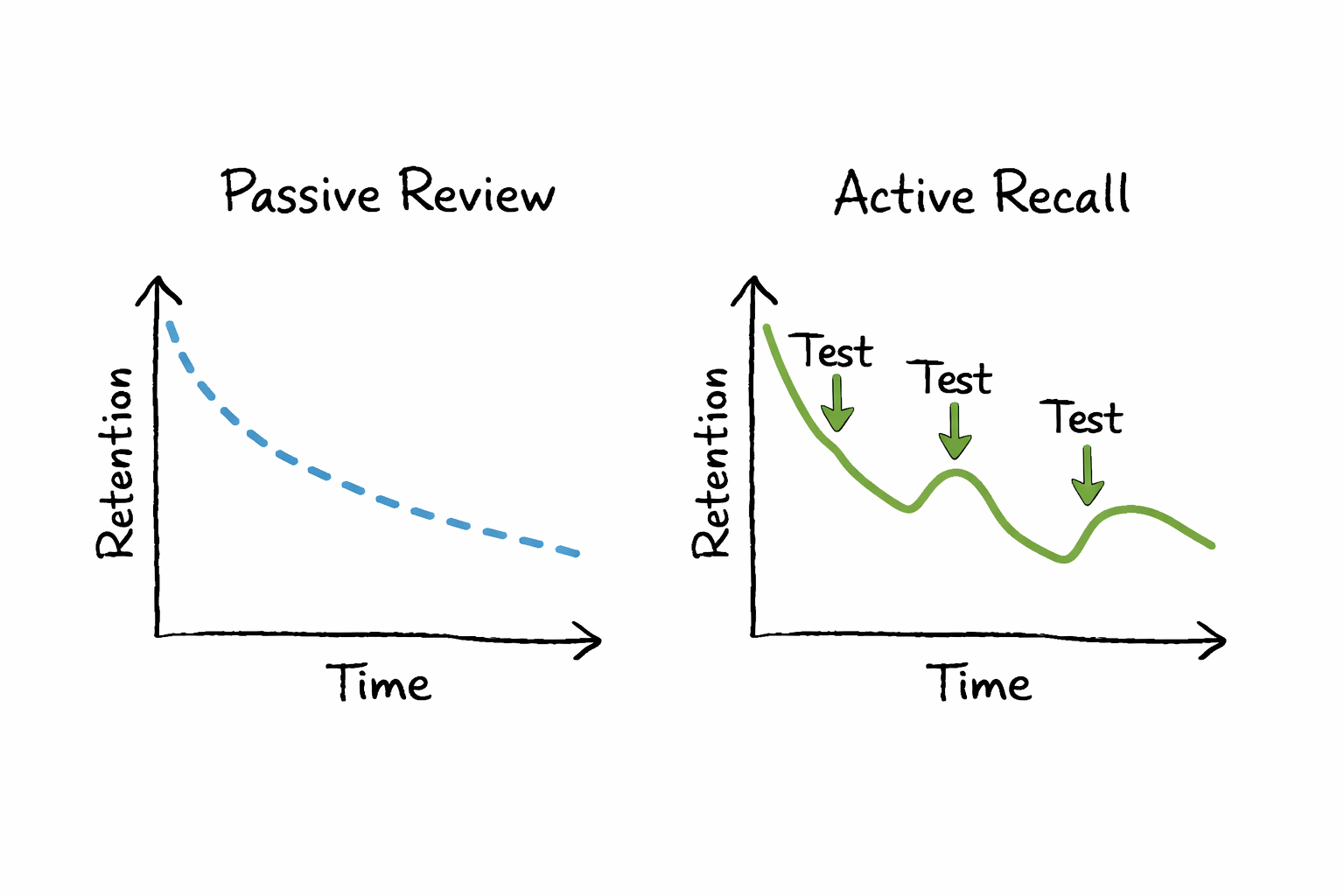
A 2013 meta-analysis published in Psychological Science in the Public Interest reviewed over 10 major study techniques and rated practice testing as having high utility — one of only two methods to receive that rating. Re-reading, highlighting, and summarizing were all rated as low utility.
Sources:
- Roediger & Karpicke, 2006 – Psychological Science
- Dunlosky et al., 2013 – Psychological Science in the Public Interest
How to Apply Active Recall in Practice
Start With a Brain Dump
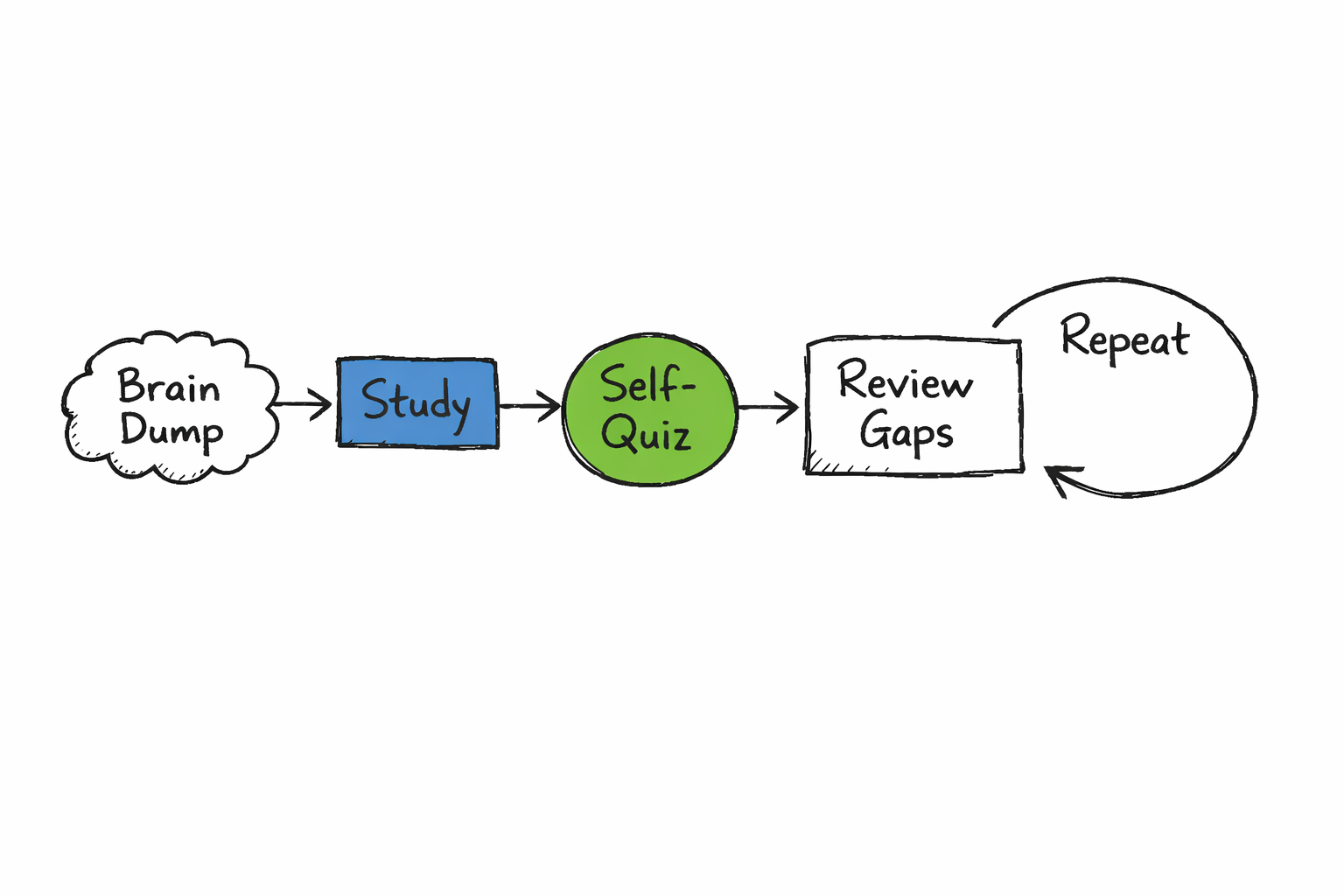
Before reviewing your notes, write down everything you already know about the topic. This forces retrieval from the start and reveals gaps you didn’t know you had.
Use Flashcards Correctly
Flashcards only work as active recall if you genuinely attempt the answer before flipping the card. Writing a question on one side and reading the answer straight away is passive. Cover the answer, try to recall it, then check.
Apps like Qsets automate the spacing between reviews based on your actual performance, so cards you struggle with appear more often without any manual sorting. This removes the overhead of managing your own review schedule.
Replace Highlighting With Questions
When reading new material, instead of underlining sentences, write a question in the margin that the sentence answers. When you review, answer the questions before re-reading the text.
Use Practice Tests Early, Not Just at the End
Most students use practice tests as a final check before an exam. Research suggests using them throughout the study period — even before you feel ready — produces stronger retention than saving them for last.
Common Mistakes When Switching to Active Recall
Treating flashcard review as passive. Looking at a card without generating an answer first defeats the purpose. Always commit to an answer before checking.
Skipping difficult material. It’s tempting to review cards you already know well. The cards you get wrong are the ones that need the most repetition.
Testing too soon after studying. Some spacing between initial learning and retrieval practice strengthens retention further. Reviewing material the same day you learned it is less effective than waiting 24 hours.
Confusing familiarity with mastery. If a concept feels familiar, that does not mean you can retrieve it under exam conditions. Test yourself under conditions similar to the actual test — timed, without notes.
Active Recall vs Passive Learning: A Quick Comparison
| Passive Learning | Active Recall | |
|---|---|---|
| Examples | Re-reading, highlighting | Flashcards, practice tests |
| Cognitive effort | Low | High |
| Retention after 1 week | Lower | Higher |
| Time efficiency | Lower | Higher |
| Common mistake | Feeling prepared without being tested | Reviewing only easy material |
FAQ
What is the difference between active recall and passive learning?
Passive learning involves receiving information without retrieving it — re-reading notes, watching videos, or highlighting text. Active recall requires you to generate information from memory before checking the source. Research consistently shows active recall produces stronger long-term retention.
How often should I use active recall when studying?
Ideally, every study session should include some retrieval practice. A simple approach: study a section, close your notes, write down what you remember, then review what you missed. Spacing sessions out over multiple days amplifies the effect.
Is spaced repetition the same as active recall?
They are related but distinct. Active recall is the method — retrieving information from memory. Spaced repetition is a scheduling system that determines when to review material, based on how well you know it. Used together, they are more effective than either alone.
Does active recall work for all subjects?
Active recall works for any subject where you need to retain and reproduce information — languages, science, history, law, and medicine are well-studied examples. For procedural skills like mathematics, the equivalent is solving problems without looking at examples rather than re-reading worked solutions.
Why does re-reading feel effective if it isn’t?
Re-reading creates a sense of fluency — the material looks familiar, which the brain interprets as knowing it. This is called the fluency illusion. Familiarity and retrievability are different things, and passive review tends to build only the former.
Conclusion
The core difference in the active recall vs passive learning debate comes down to what your brain is actually doing during a study session. Passive methods create familiarity. Active recall builds retrievable memory.
The shift is straightforward: stop reviewing material and start testing yourself on it. Use practice questions, close your notes and recall, or use flashcards the right way — attempting the answer before checking. Space your reviews out over time rather than cramming in a single session.
Tools like Qsets make it easier to apply these techniques consistently by automating when cards resurface based on your performance, so you spend review time where it matters most. But the method itself requires no app — just the habit of testing before checking.
Pick one subject you’re currently studying. Before your next session, try a five-minute brain dump first. Note what you couldn’t recall. That gap is exactly where your study time is most valuable.