Introduction
Most learners have made flashcards at some point. Many have also abandoned them after a few sessions, frustrated that they weren’t working. The problem is rarely the flashcard format itself — it’s how the cards are written.
Understanding how to make good flashcards is the difference between a deck you can actually study from and a stack of cards that test whether you can read, not whether you’ve learned. A card with too much text, a vague question, or an answer you can’t reproduce forces recognition rather than recall.
This guide walks through how to choose what goes on a card, how to phrase questions effectively, common formatting mistakes to avoid, and faster ways to build decks without sacrificing quality.
What Makes a Flashcard Effective?
A flashcard works by prompting your brain to retrieve a specific piece of information. The front of the card is a cue; the back is the target. When the cue is too broad, too complex, or too ambiguous, retrieval breaks down.
Three principles define a well-made card:
- One idea per card. Each card should test exactly one thing.
- Precise question, minimal answer. The front should make the answer unambiguous. The back should be as short as possible while still being complete.
- Your own words. Cards written in your own language are easier to recall than copied definitions.
Step 1: Choose the Right Content to Put on Cards
Not everything in your notes is worth a flashcard. Cards work best for discrete, retrievable facts — definitions, dates, formulas, vocabulary, named concepts, and cause-effect relationships.
Good candidates for flashcards:
- Vocabulary terms and their meanings
- Definitions of concepts (“What is osmosis?“)
- Named processes or sequences (“What are the steps of mitosis?“)
- Translations in language learning
- Formulas, rules, or classifications
Poor candidates:
- Long explanations that require context to understand
- Opinions or interpretations
- Procedural skills better practiced by doing (e.g., solving equations)
- Topics so interconnected that isolating one fact is misleading
If you can’t write the answer in one or two lines, the content probably needs to be broken into smaller cards first.
Step 2: Write the Question Side Correctly
The front of a card should produce exactly one correct answer in your mind. Vague prompts create ambiguity, which makes self-assessment harder and review less effective.
Use Closed, Specific Questions
Compare these two versions:
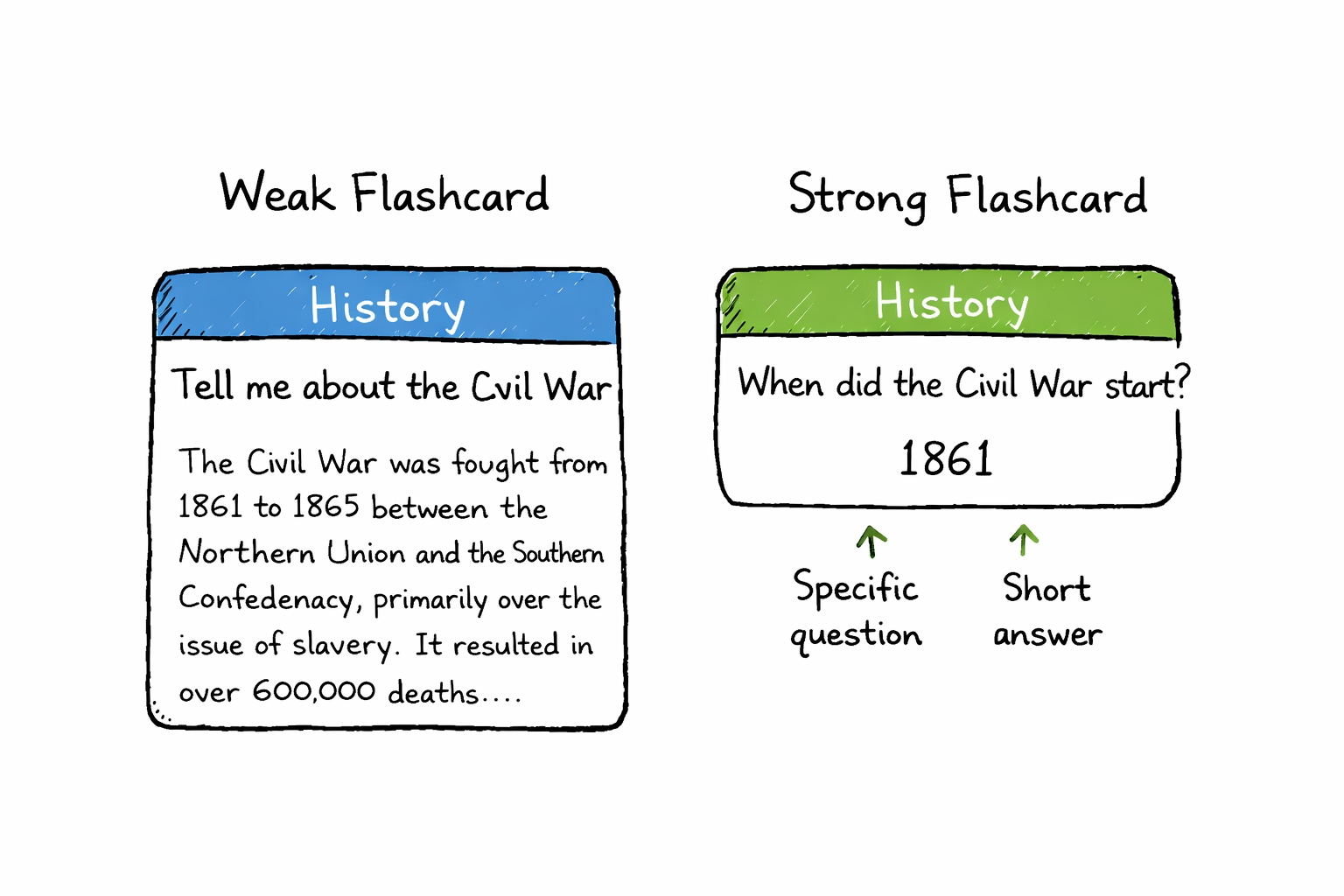
- Weak: Napoleon
- Strong: What year did Napoleon become Emperor of France?
The first requires you to decide what to recall. The second has one clear answer. Specificity is not pedantry — it makes the card trainable.
Use Fill-in-the-Blank for Definitions
For vocabulary and terms, a fill-in-the-blank format often works better than open questions:
- The process by which plants convert sunlight into glucose is called ____.
This format is more direct and tests exactly the term you’re learning.
Add Context When the Term Is Abstract
If a concept only makes sense in context, include a brief scenario or example on the front:
- A doctor prescribes a drug that blocks a receptor without activating it. What type of drug is this?
Context makes cards more memorable and closer to real-world application.
Step 3: Write the Answer Side Correctly
The back of the card should be as short as the front allows. Long answers train recognition, not recall — you end up reading rather than retrieving.
Guidelines for the answer side:
- One to five words when possible
- Use semicolons for equally correct alternate answers: photosynthesis; carbon fixation
- Optional clarifiers in parentheses are fine but shouldn’t be required to answer correctly: RAM (random access memory)
- Avoid full sentences unless the exact phrasing is what’s being tested (e.g., a quote or formula)
If the correct answer genuinely requires a longer explanation, consider whether the card needs to be split or whether a written practice question would serve better than a flashcard.
Step 4: Apply the One Idea Per Card Rule
This is the most frequently broken rule in flashcard creation, and the one with the highest cost. A card that tests two things simultaneously will be answered correctly when you know one and incorrectly when you forget the other — you lose information about what you actually know.
Example of a card that does too much:
- Front: What are the causes and consequences of the French Revolution?
- Back: [six bullet points]
Split this into separate cards: one for causes, one for consequences. If consequences can be further divided by category, divide them further.
A useful rule of thumb: if the back of a card has more than two lines, it almost certainly contains more than one idea.
Step 5: Use Mnemonics and Images Selectively
Mnemonics and images add an extra memory hook when the raw information is difficult to retain. They work best for arbitrary associations — things that don’t follow a logical pattern.
When to use a mnemonic:
- Spelling rules (i before e except after c)
- Order of items in a sequence (ROY G BIV for the color spectrum)
- Terms in another language that sound like familiar words
When to use an image:
- Anatomy, geography, or any spatial concept
- Distinguishing visually similar things (e.g., plant vs animal cell)
- Associating a word in a new language with a vivid mental picture
Don’t add images for the sake of it. A well-written text card is better than a poorly chosen image that adds noise.
Step 6: Create Cards Efficiently
Writing cards manually from scratch is slow. Two faster approaches that maintain quality:
Use AI to Generate a First Draft
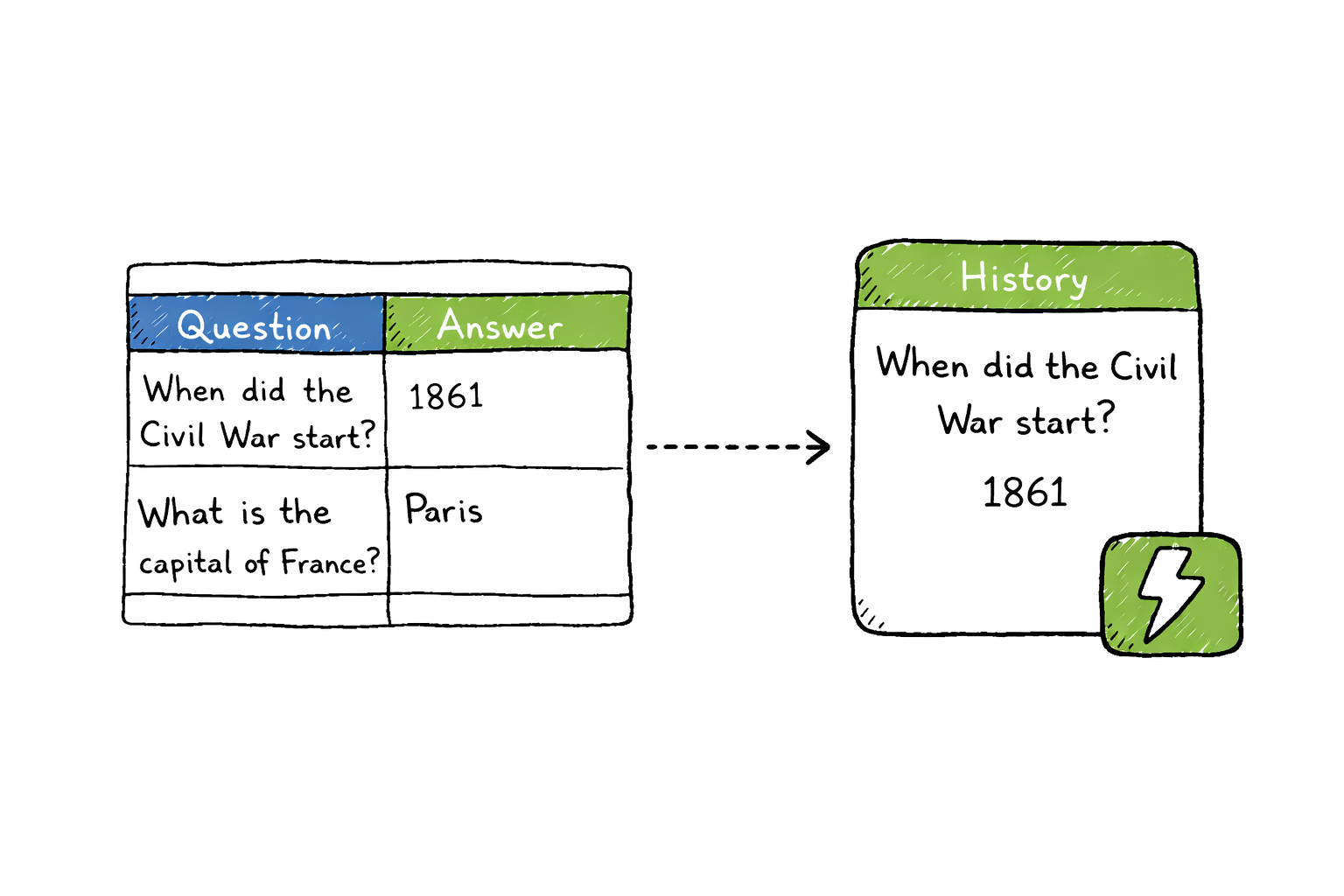
You can prompt a language model to generate cards in a structured format, then edit rather than write from scratch. A reliable prompt structure specifies the target audience, asks for short answers on the back, uses semicolons for alternate correct answers, and requests output as a two-column table in a code block — one column per side of the card. Review and trim the output before importing; AI-generated cards often err toward too much information on the back.
Import From a Spreadsheet
If you already have content in a structured format — a vocabulary list, a glossary, a study guide table — you can format it as two columns (question, answer) and import it directly. Apps like Qsets support importing cards via copy-paste from spreadsheets, which removes the manual entry step when you’re working from existing material.
Common Flashcard Mistakes to Avoid
Too much text on one card. If you need to scroll to read the answer, the card is doing too much.
Copying definitions verbatim. Textbook language is often written to be read, not recalled. Rewrite definitions in plain language you’d actually say out loud.
Never reviewing your deck. Writing cards and never studying them is a common pattern. Cards only work through repeated retrieval practice, not creation.
Only reviewing cards you already know. It feels productive to run through easy cards, but the cards you get wrong are the ones requiring more repetitions. Prioritize those.
Making cards for content you don’t understand yet. Flashcards reinforce knowledge; they don’t replace initial understanding. If you don’t understand a concept, a card won’t fix that — clarify it first, then make the card.
FAQ
How much information should one flashcard contain?
One. Each card should test a single fact, term, or concept. If you find yourself writing multiple answers, split the card. The one idea per card rule is the single most important principle in making good flashcards.
Should the question or the answer go on the front?
It depends on what you’re trying to recall. If you need to recognize a term and produce its definition, put the term on the front. If you need to hear a description and recall the term (more common in exams), put the description or question on the front and the term on the back. Both directions can be worth practicing.
How long should flashcard answers be?
As short as possible. One to five words is ideal. If the answer requires a sentence, consider whether the card is testing one thing or several. Longer answers are harder to reproduce under exam conditions and tend to encourage reading rather than recall.
Is it better to handwrite or type flashcards?
Handwriting has some evidence for improving encoding during creation, but typed digital cards offer practical advantages — searchability, easy editing, and automatic spaced repetition scheduling. For most learners, the quality of the card content matters more than the medium.
How often should I review my flashcard decks?
Review before you forget. Spaced repetition systems automatically schedule reviews at the optimal interval based on your performance — showing difficult cards sooner and well-known cards less frequently. If you’re reviewing manually, a common starting point is: review new cards after one day, then three days, then one week, then two weeks.
Conclusion
Knowing how to make good flashcards comes down to a few consistent habits: one idea per card, a specific question, a short answer, and content written in your own words. The format is simple — the discipline is in applying the rules when it’s tempting to copy a paragraph and call it a card.
Start with the content you find hardest to retain. Write three to five cards using the question-answer format described here, keep each answer to one or two lines, and test yourself before checking. That single habit will outperform an hour of re-reading.
If you’re building larger decks, tools like Qsets let you import cards from spreadsheets and handle review scheduling automatically, so you can focus on writing good cards rather than managing when to study them.